

Community Carbon Trees (ACCT)
I'm an extra long title. Click here to add your own text and edit me. It’s easy. Just click “Edit Text” or double click me to add your own content and make changes to the font. I’m a great place for you to tell a story and let your users know a little more about you.
A Living Alliance for Forest, Water, and Community
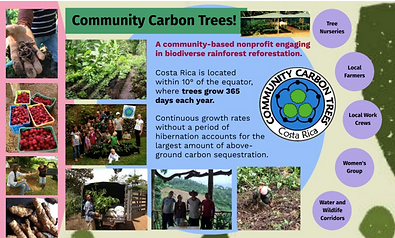
Community Carbon Trees (ACCT) is one of the few reforestation organizations in the world demonstrating what it truly means to regenerate land in integrity. Their work goes far beyond planting trees. It restores forests, watersheds, livelihoods, and long-term ecological balance through relationship, fair pay, and accountability.
This alliance exists because Chirripó Earth and ACCT share a core understanding:
lasting regeneration only happens when people, land, and future generations are cared for together.
Why This Alliance Matters
Much of what is labeled “reforestation” today fails within a decade. Trees are planted, photographed, and abandoned. In tropical climates, especially on degraded cattle land, more than 85 percent of trees die without ongoing care.
ACCT has proven a different path.
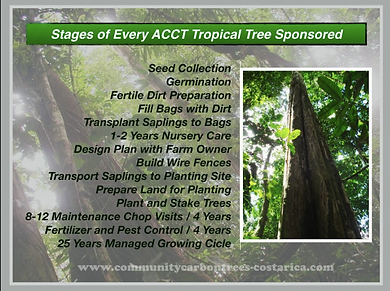
Through long-term stewardship and paid maintenance, ACCT has demonstrated tree mortality rates below 3 percent and robust growth capable of capturing at least one ton of CO₂ per tree by year twelve. This is regeneration measured in decades, not headlines.
For Chirripó Earth, alignment means working only with organizations that value depth over scale, integrity over speed, and living systems over extraction.
A Model Rooted in Fair Pay and Relationship
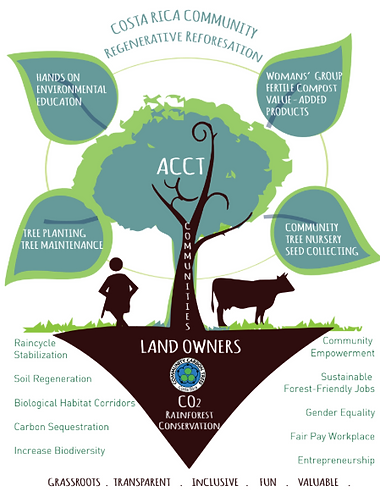
Every ACCT project is hosted on Costa Rican–owned farms. Local families are paid for the labor of planting and maintaining trees during the first four critical years of growth, with additional compensation for pruning in years five and six to ensure healthy long-term development.
This matters.
Paying people fairly for hard, physical work builds dignity, accountability, and pride. Over time, farm families form relationships with the trees they are nurturing. These relationships become protection. Communities actively defend forests they once would not have intervened for, not because of contracts, but because the forest has become part of their livelihood and identity.
No conservation agreement is more effective than a changed mindset rooted in respect and reciprocity.
Women, Food Sovereignty, and Living Forest Economies
ACCT places women at the center of its nurseries and seed collection networks, strengthening both ecological literacy and economic resilience across generations.
From these networks emerge small, sustainable forest-based businesses, including:
-
Chocolate and fruit juices made from mango, orange, grapefruit, and aloe
-
Moringa tea and medicinal syrups such as Karao and Hombre Grande
-
Gluten-free flours produced from banana and breadfruit
These enterprises directly address the root causes of deforestation: poverty and unsustainable cattle farming. When families can earn a real living from healthy forests, the pressure to clear land disappears naturally.
Living forests become more valuable standing than cut.
Forests, Water, and Climate Balance
Forests, Water, and Climate Balance
Rainforest trees near the Equator are powerful regulators of Earth’s climate systems.
Through evapotranspiration, forests recycle vast amounts of water back into the atmosphere, forming cooling cloud systems that stabilize rainfall patterns across the planet. Tree cover cools not only the air but the ground itself, allowing rainwater to soak into soils, refill aquifers, and reduce extremes of drought and flooding.
As forests mature, soils regenerate. Fungal and microbial networks return. Erosion slows. Chemical runoff into rivers and oceans decreases. Healthier watersheds protect marine ecosystems and plankton, which are also essential carbon sinks.
This is climate repair through living systems, not offsets in isolation.
Education and True Ecotourism
Education is central to ACCT’s mission.
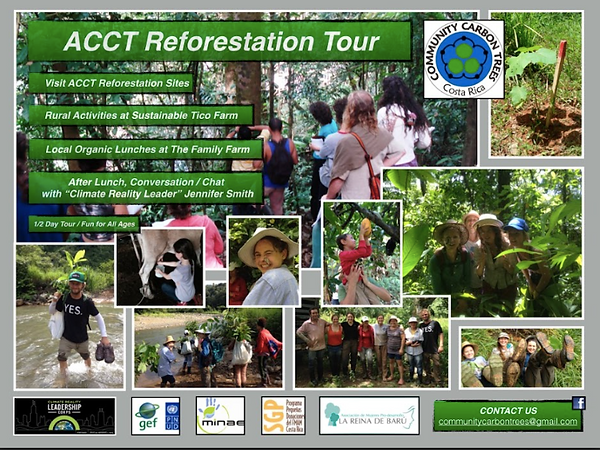
Children, adults, locals, and visitors are invited into hands-on learning through nurseries, seed collection expeditions, compost production, and planting days. These programs cultivate ecological literacy and reverence for the land, even though they are not funded by sponsorships.
ACCT also champions genuine ecotourism as a regenerative income stream. Projects such as Eco Chontales Waterfalls and Cloudbridge demonstrate how restored forests can educate, inspire, and economically support local families while protecting biodiversity.
This is not greenwashing. It is living education rooted in place.

Why Free Trees Do Not Work
After more than two decades working with government programs, United Nations initiatives, and international reforestation projects across Africa, Asia, and the Americas, ACCT leadership has seen the same pattern repeated worldwide.
Free trees do not grow forests.
Expecting people living in poverty to care for trees for years without pay exploits their situation and fails ecologically. The true measure of success is not how many trees are planted in year one, but what the forest looks like in year twelve, twenty, and beyond, and how the people living with that forest are thriving.
ACCT’s model is built on this long view.
Shared Values, Shared Future
A portion of all Chirripó Earth proceeds supports aligned initiatives including:
-
Sacred water protection
-
Land preservation
-
Tree planting and long-term forest stewardship
-
Children’s education
-
Indigenous communities
-
Earth stewardship education
-
Music Education
ACCT embodies these values in action. This alliance is not symbolic. It is a living collaboration in service to future generations.
As Chirripó Earth continues to grow, additional alliances aligned with these principles are in development. Others are actively being sought. If your organization or project resonates with this approach and lives these values on the ground, we welcome you to reach out and begin a conversation.
Explore Community Carbon Trees
Learn more about ACCT’s projects, impact, and how to support long-term rainforest regeneration in integrity.